

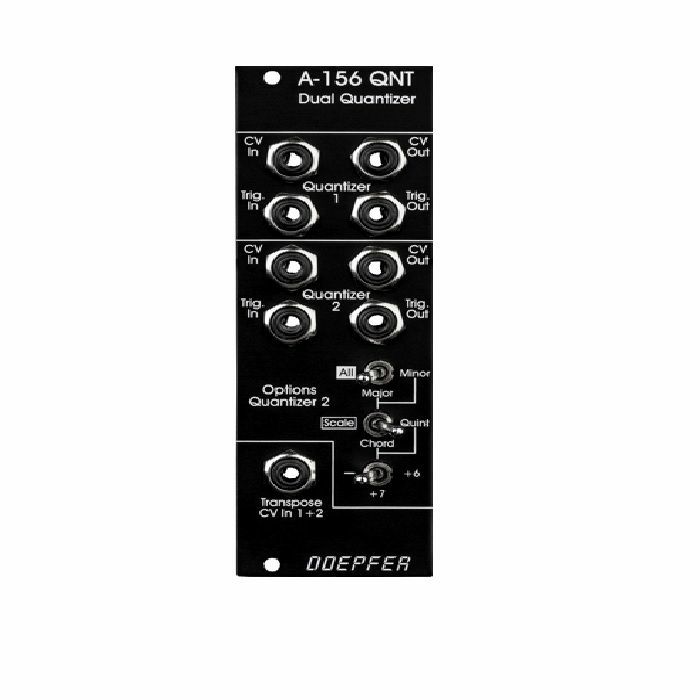
Module A-156 is a Dual Control Voltage Quantizer. A quantizer converts a continuous control voltage in the range 0...+10V into a stepped output voltage in the same voltage range (i.e. only certain voltages occur). Normally 1/12 V steps are used to obtain semitone steps. Quantizer 2 of the A-156 allows has more sophisticated quantizing modes like major scale (i.e. only voltages corresponding to the major scale), minor scale, major chord, minor chord, fundamental + fifth and addition of seventh or sixth when chords are selected. Only those voltages appear at the CV output which comply with the selection rule (e.g. minor chord with seventh). The mode setting of quantizer 2 is done with 3 switches (1-0-1 type with middle position). From the factory quantizer 1 is working in the semitone mode. But there is a jumper on the pc board that can be changed so that even quantizer 1 uses the same scale as quantizer 2.
For each quantizer the following in/outputs are available:
- Control voltage input (CV In): The input for the continuous voltage to be quantized
- Control voltage output (CV Out): The output of the quantized voltage
- Trigger input (Trig.In): If this jack is left open the quantizer is working permanently. If a rectangle voltage is applied quantisation happens only at the rising edge of the signal (e.g. from an LFO or MIDI-to-Sync interface). Thus the quantizing can be synchronized with other events
- Trigger output (Trig.Out): Whenever a quantisation happens (i.e. a new voltage is generated at the CV Out) a positive pulse occurs at this output. It may be used to trigger an envelope generator (ADSR) or for triggering other modules (sequential switch A-151, trigger divider/sequencer A-160/161, trigger delay A-162, ...). If none of these functions are used the jack is left open
On top of that the A-156 is provided with a common transpose CV input having an additive effect on both quantizers. This input is quantized in semitone steps. A typical application is the transposition of a sequence generated by the A-155 by a second control voltage (e.g. coming from the MIDI-CV interface A-190).
Typical applications:
- Quantizing the CV sequence generated by an A-155 (semitone, only major scale, only minor scale and so on)
- Quantizing the voltage coming from the Trautonium Manual / Ribbon Controller A-198, Theremin A-178 or Light-to-CV module A-179 to get accurate semitones or major/minor scale tones
- Arpeggio-like effects with LFO, random, noise, envelope generators as CV sources (for negative or symmetrical voltages an offset must be added, e.g. with the offset/attenuator module A-129-3, to obtain positive voltages for the A-156 input)
If you decide an equipment item is not suitable within 10 days of delivery, you can return it to us for a replacement or refund. Returns must be unused and in their original, undamaged packaging.
Some items are excluded from our money back guarantee, including:
• Computer software that has been unsealed or registered
• Any item that comes directly into contact with the nose, ears or mouth
To arrange a return, just contact our customer service department on 020 7424 2800 or email us at support@juno.co.uk
from Juno Records: Studio Equipment - New Releases https://ift.tt/2LLWDum

Follow Juno Records
Juno Records delivering the inside scoop on the electronic music industry. Subscribe and get dialed in on what's really going on behind the scenes.
SPONSORS
Sourced by actual house heads who have supported the EDM scene, music, culture, and vibe collectively for decades. We're always dedicated to showing love and support for fellow artists, promoters, and supporters.

Lurid House Live and the Lurid's Playhouse formats each session for live broadcast. Enjoy the show.
ConversionConversion EmoticonEmoticon