

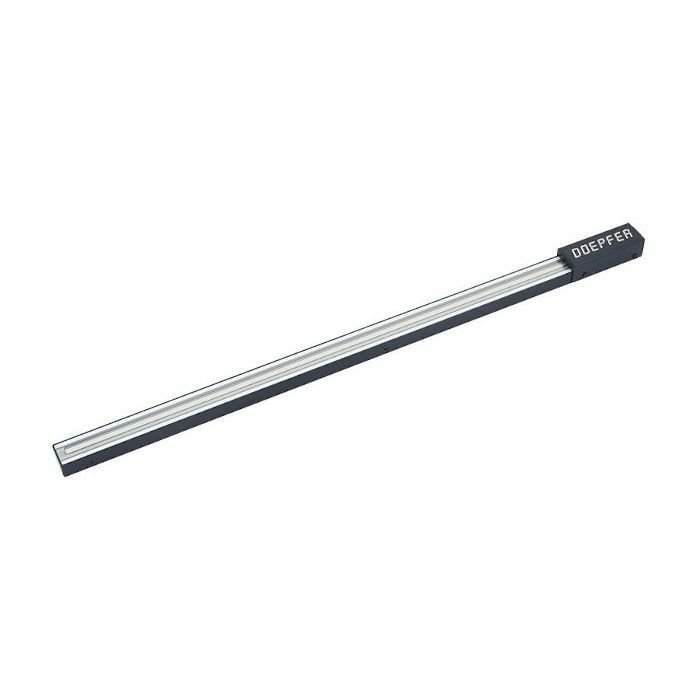
R2M is a ribbon controller that generates control signals by moving the finger on the ribbon manual. The output signals are generated as MIDI and CV / Gate control voltages simultaneously. Consequently R2M allows to control both MIDI and CV / Gate based equipment (e.g. analogue synthesisers or analogue modular systems). R2M is the abbreviation for Ribbon to (2) MIDI.
R2M is made of two parts: the manual and the control box. For the manual the same type as the for the modular version A-198 is used. It includes a 50 cm position sensor and a pressure sensor. The control box converts the data coming from the manual (finger position and pressure) into the corresponding MIDI data resp. CV / Gate voltages. The control box is available even without manual to make use of an already existing A-198 manual and take advantage of the additional features of the R2M control unit compared to the comparatively simple A-198.
Module A-198 is a Trautonium Manual resp. Ribbon Controller. The controlling element of the A-198 is a linear position sensor (length about 50 cm) hat has available a pressure sensor too.
Touching the sensor with a finger generates a control voltage CV1 that is proportional to the position of the finger. The scale (i.e. the relation between position difference and voltage difference) is adjustable with a potentiometer at the front panel. A hold switch is used to determine if the CV voltage is held after removing the finger (hold = on) or if the CV voltage jumps to 0V (hold = off). In the last case (hold = off) a gate signal is derived from the CV voltage whenever a finger touches the sensor (e.g. for triggering an envelope generator).
A sensitive pressure sensor located below the position sensor generates a second control voltage CV2 that increases with higher pressure of the finger. Even for CV2 the scale is adjustable. A second gate signal is triggered as soon as the pressure exceeds a certain value. The gate threshold is adjustable at the front panel.
The sensors are located in a separate metal frame (length about 600 mm, width about 30 mm, height about 18 mm, weight: about 900 g, colour: silver-grey). The connection between the module and the sensor frame is made by a 4 pin cable (same as used for USB connections).
Typical applications:
- Trautonium manual, the string is replaced by the position sensor that is much easier to use and cheaper than the string. In combination with the Subharmonic Oscillator A-113, the Trautonium Filter A-104 and some auxiliary modules a complete Trautonium replica may be realized. In combination with the Quantizer A-156 exact semitone intervals are possible.
- Ribbon Controller for any A-100 parameter (e.g. pitch, filter frequency, loudness, panorama, speed, modulation depth and so on)
If you decide an equipment item is not suitable within 10 days of delivery, you can return it to us for a replacement or refund. Returns must be unused and in their original, undamaged packaging.
Some items are excluded from our money back guarantee, including:
• Computer software that has been unsealed or registered
• Any item that comes directly into contact with the nose, ears or mouth
To arrange a return, just contact our customer service department on 020 7424 2800 or email us at support@juno.co.uk
from Juno Records: Studio Equipment - New Releases https://ift.tt/2rIjjWl

Follow Juno Records
Juno Records delivering the inside scoop on the electronic music industry. Subscribe and get dialed in on what's really going on behind the scenes.
SPONSORS
Sourced by actual house heads who have supported the EDM scene, music, culture, and vibe collectively for decades. We're always dedicated to showing love and support for fellow artists, promoters, and supporters.

Lurid House Live and the Lurid's Playhouse formats each session for live broadcast. Enjoy the show.
ConversionConversion EmoticonEmoticon