

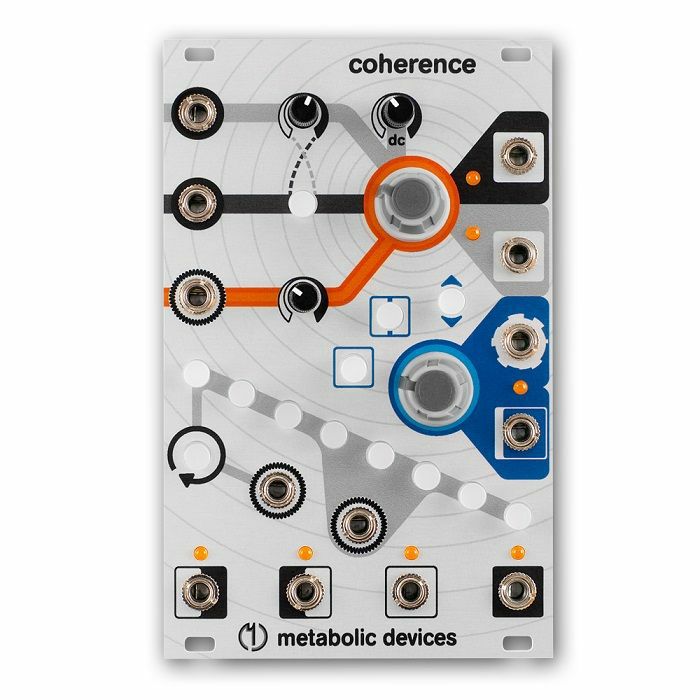
Modulation sources like LFOs and wavetables are typically boring and overly repetitive, while chaos-type CV sources are contextually irrelevant and untethered from compositional space. Coherence is a new type of module which allows order to be derived from unrelated periodic signals. In other words it is a new class of module that listens to multiple inputs and derives a relevance between those inputs which is called coherence. Unique patterns of gates, triggers, and stepped CVs emerge depending on the characteristics of the input signals and the settings of coherence. Adjustments of one control often affects the output in multiple ways so changes are faster and its easy to move your track from one zone to the next.
Coherence is equipped with two input channels, meant for modulation voltages coming from LFOs, envelopes and the like. One of these signal paths features a bipolar attenuator and an adjustable offset generator. (Control range: -5 V to +5 V.) An application example: If the pitch signals generated by Coherence are too high, simply add a negative offset. The other way round, low melodies can be transposed upwards using a positive offset. If only one modulation signal is available, the offset generator may serve as a fixed voltage source. The inputs of both channels can be swapped quickly via a button.
The window comparator is edited using the potentiometer highlighted in orange. In other words, this control element determines the distance to which the input signals are considered coherent. A CV input with bipolar attenuator allows you to influence the window via modulation signals. A coherence output (marked black) and an incoherence output (marked grey) emit gate signals (+5 V) if the distance between the first and second input signals is smaller respectively larger than the coherence value.
The blue front panel section is responsible for generating melodies. At the heart of the associated circuitry, you'll find a S&H stage. The calculations performed by the Coherence module to determine pitch CV values are quite complex. The most important factor is which voltages are applied to the window comparator at the moment the S&H stage gets activated. You can choose from several trigger modes via three buttons:
First mode: Each time the divider (see below) emits a gate signal, a new pitch CV voltage is generated.
Second mode: Each time the input signals at the window comparator are considered equal, a new pitch CV voltage is generated.
Third mode: Each time the waveform at the second input channel changes its direction (upward / downward), a new pitch CV voltage is generated.
By pressing several mode buttons simultaneously, two or more trigger types can be combined. A potentiometer allows you to alter the pitch range manually. Besides the note CV output, there is a trigger out (+5 V, 2 milliseconds). This socket becomes active whenever the note voltage changes. Together, the outputs can be used for controlling a synthesizer voice. Notes with sustain phase may be generated by combining the pitch CV output and the coherence output (marked black).
The divider is fed with gate signals coming from the coherence output of the window comparator as well. A divisor (from 1 to 16) can be set via a row of buttons, so that only every x times an incoming voltage is actually passed on by the divider. A trigger input allows you to reset the circuit. Results are emitted via four gate outputs:
1 / 2 output: Goes high (+5 V) every time a signal is sent from the window comparator to the divider. It becomes inactive again as soon as both input signals are considered equal or incoherence occurs.
2 / 2 output: Goes high (+5 V) every time both input signals are considered equal. It becomes inactive again as soon as incoherence occurs.
Divider output: Goes high (+5 V) every time the number of steps set in the divider is reached. The gate length corresponds to the sum of output 1 / 2 and 2 / 2.
Remainder output: Goes high (+5 V) every time the step count increases, but the gate signal is suppressed by the divider.
The most harmonious results are achieved by Coherence when fed with slowly rising and falling signals. Triangle waves or slow envelope voltages, for instance. In addition to periodic material, one-shots are suitable as well. Waveforms with steep edges, such as a rectangle, often lead to unpredictable results. The same goes for modulation signals fed to the window comparator. Here, however, rectangle or pulse waves may be used to create song structures reminiscent of verse and chorus.
Dimensions
16 HP
25 mm deep
Current Draw
50 mA +12V
70 mA -12V
0 mA 5V
If you decide an product is not suitable within 14 days of delivery, you can return it to us for a replacement or refund. Returns must be unused and in their original, undamaged packaging.
Some items are excluded from our money back guarantee:
- Computer software that has been unsealed or registered
- Any item that comes directly into contact with the nose, ears or mouth
To arrange a return, just contact our customer service department on 020 7424 2800 or via our customer support form.
from Juno Records: Studio Equipment - New Releases https://ift.tt/KbSReT8

Follow Juno Records
Juno Records delivering the inside scoop on the electronic music industry. Subscribe and get dialed in on what's really going on behind the scenes.
SPONSORS
Sourced by actual house heads who have supported the EDM scene, music, culture, and vibe collectively for decades. We're always dedicated to showing love and support for fellow artists, promoters, and supporters.

Lurid House Live and the Lurid's Playhouse formats each session for live broadcast. Enjoy the show.
ConversionConversion EmoticonEmoticon