

WHO? Noon
WHAT? An 8 channel powerless instrument which is activated and modulated using voltage from external sequencers.
HOW? Analog circuits are powered momentarily by incoming gate and control voltage signals causing them to oscillate and breath naturally. When these circuits are linked together they can grow, inform and process one another in complex rhythmic ways.
WHY? This technique increases the unstable properties of analogue circuits, causing increased organic textures and movement. The simple controls are provided to ensure immediacy and access to rapidly alter sounds and movement without patching.
WHERE? The simplicity of the interface was designed with live performance in mind. The number of internal and external variables (control voltage types, linked channel behaviour plus external audio input) create lots of room for studio exploration.
WHEN? Pre-orders are expected to be open by the end of January 2022.
IN-DEPTH
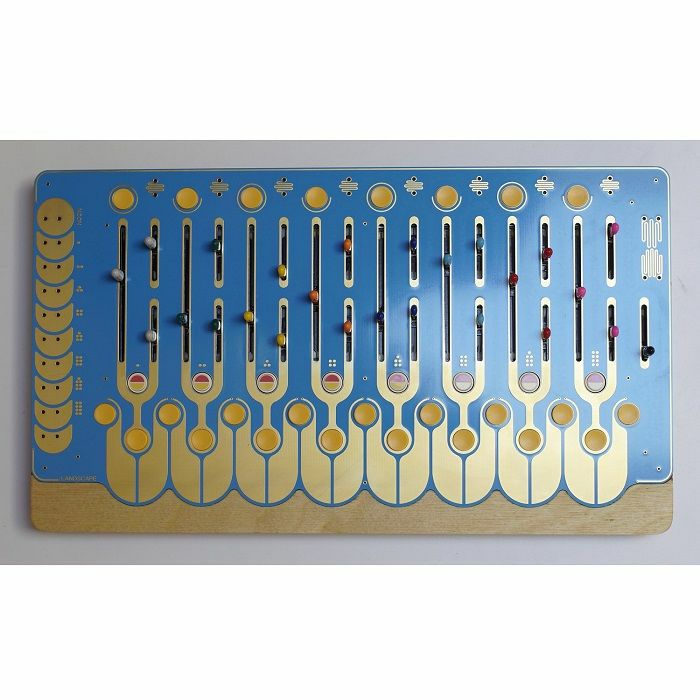
NOON is a passive analogue drum / synthesizer. Each of the eight channels uses a unique analogue circuit with its own characteristics. No power supply is needed. Each circuit is triggered and powered individually from incoming gates or control voltages provided by voltage sequencers or modular systems. By using this unique method, we can increase instability and magnify organic aspects of traditional analogue electronic instruments. The sound of analogue, at its core, is the sound of sculpted electricity. By removing the stabilizing elements of a constant power source, we can listen to the sound of electronic circuits loading and unloading, powering up and powering down, and we can increase the natural chaotic movement of electricity. The loading of circuits creates natural ways to access swing and groove or ways to deconstruct a programmed rhythm sequence to make surprisingly new ideas.
Each channel is represented by a tuning fork. Incoming voltage can be thought of as a way to "strike" each fork with momentary voltage. Between every channel there are Link buttons which allow voltage sharing between channels. Linking them provides a wide mix of results depending on incoming voltage, active or inactive channels, slider settings, gate lengths and multichannel linking. The results can be described as cross modulation, growth (creating a larger and more complex circuit), or processing (filtering, distortion). Due to the cycles of voltage and this inherent instability, a definition of what is actually occurring between channels can be hard to pin down. The eight Mod buttons, which are located at the bottom of each tuning fork, change the behaviour and sound of each circuit. The eight latching CV buttons along the top allow the "?" Even and "?" Odd CV modulation inputs to route to even and odd channels. When incoming CV is unmuted, a channel's behaviour can change drastically and this behaviour can change further when channels are linked. These CV inputs are a way to add microtonal pitch changes and / or large textural movement to voices. The Even and Odd CV inputs are summed to their respective channels to provide a rhythmic modulation reference between multiple channels.
Limitations & Recommendations
A voltage sequencer, modular system or some form of external control voltage is required for use. This is a powerless instrument which relies upon receiving voltage and control from external sources.
Using sequencers which have the ability to vary gate length is highly encouraged due to the increase in sound possibilities and rhythmic movement.
Each model of voltage sequencer can have slightly different effects on the tonality of the instrument due to variations between manufacturers and feature sets.
Given the passive design of the device the reaction of the touch plates will vary greatly based upon what voltages are being received in which channel, if channels in are being touched in tandem, skin moisture and gate lengths. Using only trig signals can significantly lessen the touch plate response.
Channels 7 & 8 (Larynx & Bacid) will give best results being fed gate and cv voltage simultaneously. Sending trigs instead of gates to these channels may have less interesting results than found in other channels.
Specifications
Dimensions: 32cm x 18cm x 2.5cm / 12.5" x 7" x 1"
Materials: Gold plated PCB (2mm fiberglass) / routed Birch plywood case with clear coat / metal shaft sliders with rubber caps / concave and dual LED latching push buttons
Weight: 0.9 kg. / 2 lbs.
CV Inputs: 10 x 3.5mm jacks
Audio Input: 1 x 3.5mm jack
Audio Outputs: 10 x 3.5mm jacks
If you decide an product is not suitable within 14 days of delivery, you can return it to us for a replacement or refund. Returns must be unused and in their original, undamaged packaging.
Some items are excluded from our money back guarantee:
- Computer software that has been unsealed or registered
- Any item that comes directly into contact with the nose, ears or mouth
To arrange a return, just contact our customer service department on 020 7424 2800 or via our customer support form.
from Juno Records: Studio Equipment - New Releases https://ift.tt/SeixRsh

Follow Juno Records
Juno Records delivering the inside scoop on the electronic music industry. Subscribe and get dialed in on what's really going on behind the scenes.
SPONSORS
Sourced by actual house heads who have supported the EDM scene, music, culture, and vibe collectively for decades. We're always dedicated to showing love and support for fellow artists, promoters, and supporters.
Lurid House Live and the Lurid's Playhouse formats each session for live broadcast. Enjoy the show.
ConversionConversion EmoticonEmoticon